Understanding inventions not patentable is essential for researchers, entrepreneurs, startups, and students. Innovation plays a crucial role in technological advancement, economic growth, and societal development. However, not every idea or invention qualifies for patent protection. While patents are designed to reward inventors with exclusive rights, the law also sets clear boundaries on what can and cannot be patented. Filing a patent for a non-patentable invention can lead to rejection, loss of time, and unnecessary costs. Therefore, knowing these exclusions in advance helps in making informed decisions and strengthening your intellectual property strategy.
This blog provides a comprehensive and detailed explanation of inventions that are not patentable under Indian patent law, along with practical insights and examples.

What is a Patent?
A patent is a legal right granted by the government to an inventor, giving them exclusive rights to make, use, sell, or license their invention for a specified period, usually 20 years. In exchange, the inventor must fully disclose the invention to the public. However, to qualify for a patent, an invention must satisfy three essential criteria:
- Novelty (it must be new)
- Inventive Step (it must not be obvious)
- Industrial Applicability (it must be useful in industry)
Even if an invention satisfies these conditions, it may still be excluded from patentability if it falls under Sections 3 and 4 of the Patents Act, 1970.
Legal Structure for Inventions Not Patentable
Under the Indian Patent Act, 1970 certain inventions are explicitly excluded from patentability. These exclusions are primarily covered under:
- Section 3 – What are not inventions
- Section 4 – Inventions relating to atomic energy
These provisions ensure that patents are granted only for genuine technological advancements and not for abstract ideas, unethical innovations, or discoveries that should remain in the public domain.
Section-3 – What are not Inventions
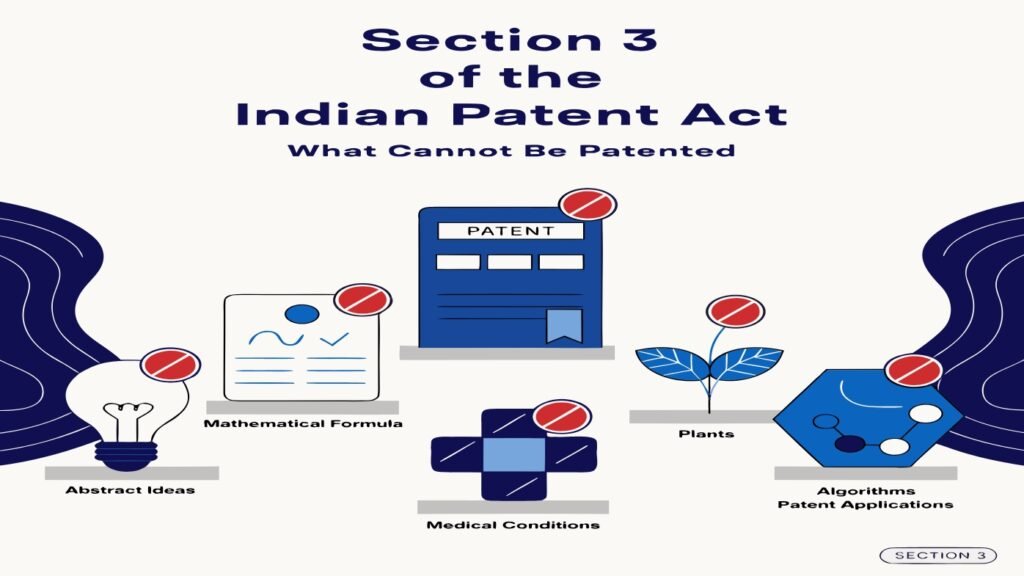
Sec- 3(a) – An invention which is frivolous or which claims anything obviously contrary to well established natural laws
An invention cannot be patented if it is impractical or unfeasible in the actual world. For instance, a machine that claims to generate energy without any input such as a perpetual motion machine is prohibited.
The patent office rejects such inventions because they violate fundamental scientific principles.
Sec- 3(b)- an invention the primary or intended use or commercial exploitation of which could be contrary to public order or morality or which causes serious prejudice to human, animal or plant life or health or to the environment
Any invention that is harmful to society, public health, or morality cannot be patented.
Examples include:
- Devices for illegal activities
- Technologies promoting violence
- Harmful biological experiments
The law ensures that patents do not encourage unethical or dangerous innovations.
Sec-3 (c) the mere discovery of a scientific principle or the formulation of an abstract theory or discovery of any living thing or non-living substance occurring in nature;
Discovering something that already exists in nature does not qualify as an invention.
Examples:
- Discovery of a new plant species
- Identifying a natural mineral
- Finding a naturally occurring compound
However, if a practical application or modification is developed, it may become patentable.
Sec- 3(d) the mere discovery of a new form of a known substance which does not result in the enhancement of the known efficacy of that substance or the mere discovery of any new property or new use for a known substance or of the mere use of a known process, machine or apparatus unless such known process results in a new product or employs at least one new reactant.
Explanation.—For the purposes of this clause, salts, esters, ethers, polymorphs, metabolites, pure form, particle size, isomers, mixtures of isomers, complexes, combinations and other derivatives of known substance shall be considered to be the same substance, unless they differ significantly in properties with regard to efficacy
This means that merely making minor modifications to an already-existing product, including altering its form, structure, or composition, does not make it eligible for a patent unless the new version significantly improves its functionality.
This clause was primarily put in place to stop “evergreening,” which is the practice of businesses, particularly in the pharmaceutical industry, attempting to extend their patent rights by making little changes without making any progress.
For Example:
A medicine will not be deemed patentable if a business modifies its crystalline form without improving its medicinal efficacy.
Sec- 3(e) a substance obtained by a mere admixture resulting only in the aggregation of the properties of the components thereof or a process for producing such substance
To put it another way, a patent cannot be obtained by simply combining two or more recognized chemicals. The combination must exhibit a synergistic impact, which means that the overall outcome should be superior to or distinct from the effects of each component alone.
The invention won’t be eligible for patent protection if the materials just function on their own without any additional benefits.
For Example:
It cannot be patented if two known substances are combined and the outcome is simply the sum of their separate characteristics, with no new or improved effects.
Sec- 3(f) the mere arrangement or re-arrangement or duplication of known devices each functioning independently of one another in a known way
Put another way, obtaining a patent requires more than simply assembling already-existing products. The combination must demonstrate a functional relationship in which the devices cooperate to get an improved or different result.
The invention is not patentable if each gadget operates independently and does not contribute to a new function.
Example:
It is not possible to patent a gadget that combines a fan and a light without any interaction between them since both parts carry out their regular tasks without any enhancements.
Sec- 3(h) a method of agriculture or horticulture
Agricultural and horticultural methods are excluded from patentability.
Examples:
- Methods of cultivating crops
- Techniques of irrigation
- Plant growing processes
These are considered traditional practices and are kept free for public use.
Sec- 3(i) any process for the medicinal, surgical, curative, prophylactic diagnostic, therapeutic or other treatment of human beings or any process for a similar treatment of animals to render them free of disease or to increase their economic value or that of their products
Methods of treatment for humans or animals are not patentable.
Includes:
- Surgical methods
- Therapeutic methods
- Diagnostic methods
This ensures that medical professionals can treat patients without any legal restrictions
Sec- 3(j) plants and animals in whole or any part thereof other than micro organisms but including seeds, varieties and species and essentially biological processes for production or propagation of plants and animals
It declares that animals and plants are not patentable in whole or in part. This covers animal breeds, seeds, and plant kinds.
The purpose of this provision is to prevent exclusive ownership over naturally occurring living organisms and to ensure that such resources remain accessible to the public.
However, if they satisfy the necessary patentability requirements, such as novelty, inventive step, and industrial use, microorganisms and genetically modified organisms (GMOs) might be eligible for patent protection.
Examples:
• Plant varieties
• Animal breeds
Sec- 3(k) a mathematical or business method or a computer programme per se or algorithms
Intellectual notions and abstract ideas are not patentable. This covers algorithms, business strategies, mathematical techniques, and computer programs on their own. To put it simply, concepts that are only theoretical or lack a useful technical application are not eligible for patent protection.
On the other hand, a computer program may be patentable if it is integrated with hardware or generates a technical effect or technical solution.
Comprises:
- Formulas in mathematics
- Business tactics
- Algorithms
- Models of finance
Sec- 3(l) a literary, dramatic, musical or artistic work or any other aesthetic creation whatsoever including cinematographic works and television productions
Artistic, musical, theatrical, and literary works cannot be patented. Instead of patent law, copyright law protects these kinds of works. To put it simply, since they do not entail a technological invention, creative works that emphasize expression, design, or artistic value cannot be patented.
For instance:
- Books
- Music
- Paintings
- Designs
Different intellectual property regulations, such copyright, which protects the creator’s rights over their original content, apply to these works.
Sec- 3(m) a mere scheme or rule or method of performing mental act or method of playing game
According to Section 3(m), information presentation alone is not an invention and cannot be patented.
To put it simply, since there is no technical innovation involved, the way information is presented, organized, or delivered does not qualify for patent protection.
For instance:
- Formats for displays
- Information presentation layout designs
Sec- 3(n) a presentation of information
According to Section 3(n), traditional knowledge or knowledge that is already known within a community cannot be patented.
To put it simply, concepts or methods that have been a part of public or indigenous knowledge for many generations cannot be claimed as fresh innovations. By preventing others from unfairly exploiting their expertise, this clause helps safeguard the rights of local and indigenous groups.
Example:
- Herbal treatments
- Traditional medical procedures
This guarantees that such information will always be available and won’t be abused through patent claims.
Sec- 3(o) topography of integrated circuits
Topography of integrated circuits is not patentable in India, according to Section 3(o). To put it simply, patent law does not cover the architecture or design of electrical circuits, like microchips.
This is due to the fact that circuit layouts are explicitly protected by a different legislation called the Semiconductor Integrated Circuits Layout-Design Act.
Sec- 3(p) an invention which in effect, is traditional knowledge or which is an aggregation or duplication of known properties of traditionally known component or components
According to Section 3(p), an innovation is not eligible for patent protection if it is primarily based on traditional knowledge or is merely a synthesis of recognized characteristics of traditionally known components.
To put it simply, you cannot obtain a patent for anything that is already well-known in conventional methods or for just mixing well-known substances without producing anything novel or better.
The purpose of this clause is to safeguard the rights of communities that have created and conserved traditional knowledge over time and to stop its exploitation.
For example:
An herbal composition will not be deemed patentable if it is made by merely combining well-known traditional constituents without producing any novel or improved effects.
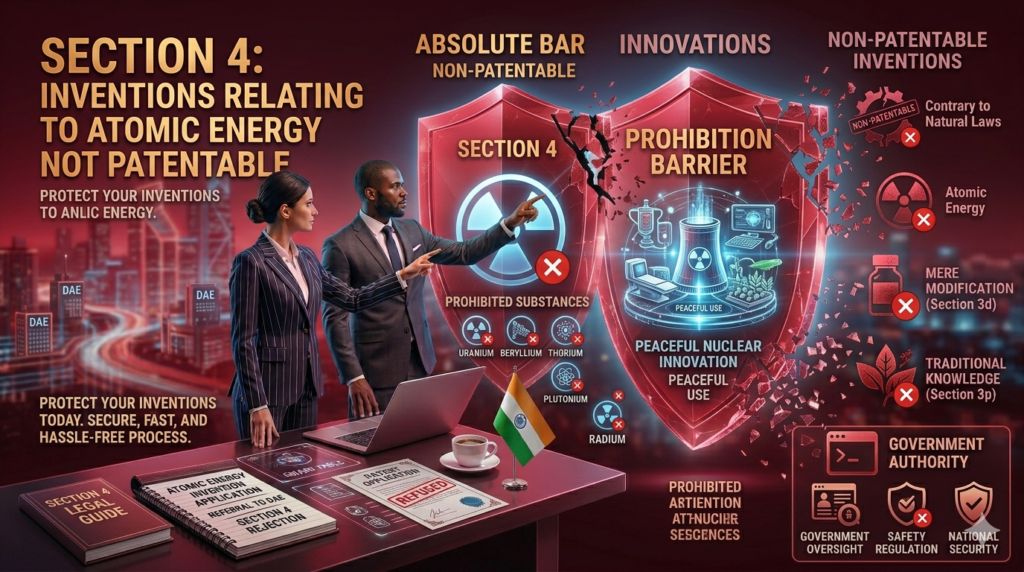
Section 4- Inventions relating to atomic energy not patentable
No patent shall be granted in respect of an invention relating to atomic energy falling within sub-section (1) of section 20 of the Atomic Energy Act, 1962 (33 of 1962).
To put it simply, an innovation cannot be given a patent if it is related to atomic energy and is covered by the Atomic Energy Act of 1962.
For purposes of public safety and national security, the government closely regulates the sensitive field of atomic energy, which is why this ban is in place.
The Reasons for These Exclusions
The exclusions have a reason and are not random.
- Prevent patent rights from being abused
- Encourage moral innovation
- Assure the public’s access to crucial information
- Steer clear of monopolies on natural discoveries.
- Promote real technical progress
Consequences for Inventors in Practice
Knowing what not patentable aids is in:
- Preventing patent applications from being rejected
- Reducing expenses and time
- Developing a better patent drafting approach
- Finding opportunities for innovation
Conclusion
Not all inventions are eligible for patent protection, and understanding these limitations is just as important as knowing what can be patented. The Indian patent system is designed to strike a balance between rewarding innovation and protecting public interest.
By clearly identifying inventions that are not patentable, inventors can refine their ideas, focus on genuine innovations, and improve their chances of securing a patent.
If you are working on a new idea, it is always advisable to evaluate its patentability at an early stage. A well-informed approach can save time, reduce costs, and ensure that your innovation receives the protection it truly deserves.
Final Thought
Innovation without protection is risky but filing without understanding patentability is even riskier. Make informed decisions and build strong intellectual property assets.