
Complete Guide to Tracking, Understanding, and Managing Your Patent Application
Patent Filing Status in India is a critical aspect of the patent process that every inventor, researcher, and organization must understand. While filing a patent marks an important milestone, the journey does not end with submission. Actively tracking and interpreting the status of your patent application plays a vital role in ensuring its successful progress.
For many applicants, terms such as Published, FER Issued, and Abandoned can be confusing. A lack of clarity around these statuses may lead to missed deadlines, unnecessary delays, or even the rejection of the application.
In this blog, we provide a comprehensive and practical guide to patent filing status in India, explaining how to check your application status, understand its various stages and timelines, and apply expert strategies to manage your patent efficiently.

What is Patent Filing Status?
The term ‘patent filing status’ refers to the stage of a patent application as it progresses through various legal and technical processes before being granted or rejected.
A patent application is not granted immediately upon submission; rather, it undergoes multiple stages, each reflected in its status, including publication, examination, and responses to objections.
Monitoring this status benefits applicants in the following ways:
- Tracking developments
Applicants can stay informed about the progress of their application by regularly monitoring its patent filing status. This allows them to determine whether the application has advanced to the publication, examination, or grant stages.
- Meeting deadlines on time
Patent procedures involve strict deadlines, particularly for responding to examination reports. By regularly monitoring the application status, applicants can avoid rejection or abandonment by ensuring that all critical deadlines are met.
- Understanding examiner actions
By reviewing status updates, applicants can identify when the examiner has issued reports or objections. This enables them to prepare appropriate responses and enhances the likelihood of patent approval.
- Planning commercialization strategies
By understanding the status of their patent, applicants can make informed decisions regarding marketing, licensing, or investing in their innovation. For example, a published or granted patent enhances credibility and creates greater business opportunities.
Where is Patent Filing Status Maintained?
The Indian Patent Office is responsible for maintaining and updating the status of patent filings in India.
Its official website provides a platform for users to check the progress of their patent applications, enabling applicants, researchers, and the public to monitor application status in real time.
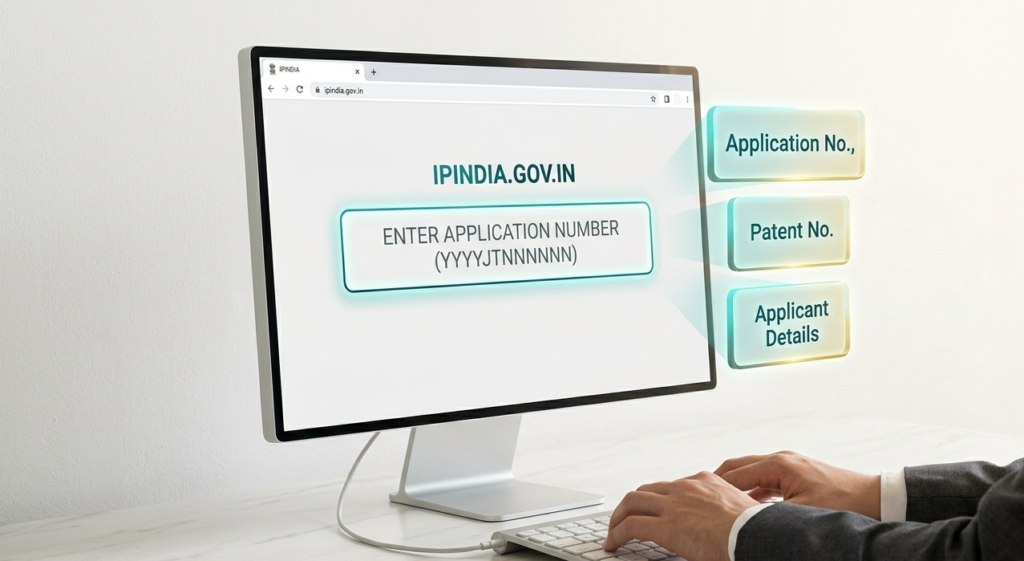
Applicants can check their status online using:
- Application number
The application number is a unique identifier assigned to each patent application at the time of filing. It is the most accurate and commonly used method to track the exact status of a patent application.
Indian Patent Application Number Format
The official format in India is: YYYYJTNNNNNN
YYYY: Four digits for the year of filing (e.g., 2025).
J: Single digit for the jurisdiction/office:
1 = Delhi
2 = Mumbai
3 = Kolkata
4 = Chennai.
T: Single digit for the type of application:
1 = Ordinary
2 = Ordinary-Divisional
3 = Ordinary-Patent of Addition
4 = Convention
5 = Convention-Divisional
7 = PCT National Phase.
NNNNNN: Six-digit, zero-padded continuous running serial number for all offices (e.g., 000123).
Example:
Application: Ordinary application filed in Chennai in 2025, serial 123.
Correct Format: 202541000123
- Patent number
Once a patent is granted, it is assigned a patent number. Applicants can use this number to track the status, legal standing, and details of the granted patent.
- Applicant details
Applicants can also search using details such as the name of the inventor or applicant. This method is useful when the application number is not available, although it may show multiple results.
The system provides real-time updates, making it easier to track your application.
How to Check Patent Filing Status in India
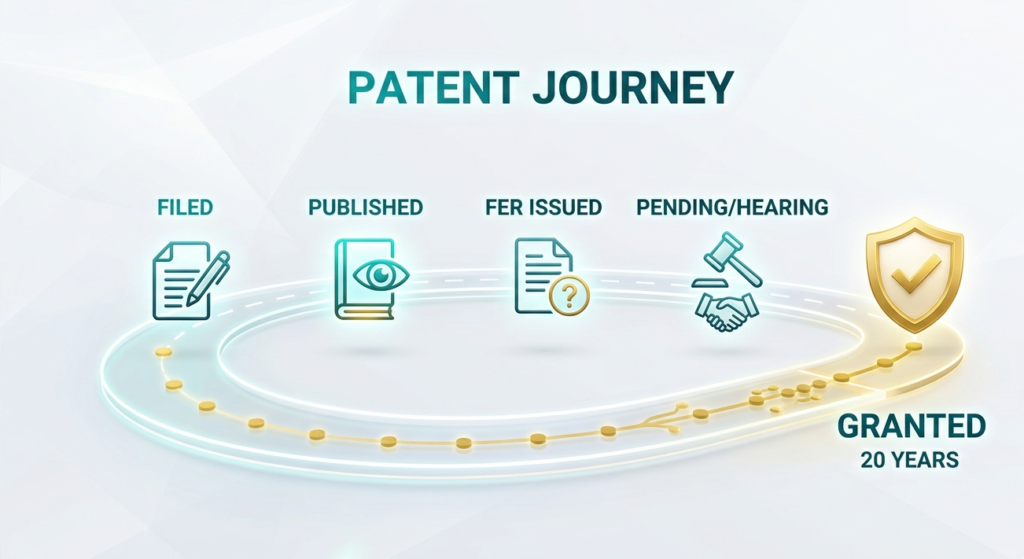
Checking patent status is simple and can be done online.
Step-by-step process:
- Visit the official patent search portal
- Click on Application Status
- Enter:
- Application number OR
- Patent number
- Click Search
The system will display the latest status and complete history of your application.
Stages of Patent Filing Status
A patent application goes through several stages before it is granted. Understanding each stage is important.
- Application Filed
This is the initial phase in which:
- The application is submitted.
- An application number is assigned.
- The filing date is recorded.
This filing date is crucial because it establishes priority rights over the invention.
- Publication
The application is published in the patent journal after filing.
- The standard timeline is 18 months from the filing date.
- Early publication is possible upon request.
After publication:
- The invention is made available to the public.
- Legal protection effectively begins from the date of publication.
- Request for Examination (RFE) Filed
- The examination process is not automatically initiated upon the filing of a patent application.
- The applicant is required to submit a Request for Examination (RFE) to initiate the examination procedure.
- This request must be filed within 31 months from the priority date of the application.
- Failure to submit the RFE within the prescribed time limit will result in the application being deemed abandoned.
- Under Examination
At this stage, a patent examiner reviews the application to determine whether it complies with the applicable technical and legal requirements.
The following criteria are evaluated as part of the examination:
- Novelty: whether the invention is new and has not been disclosed in prior art.
- Inventive Step: whether the invention is non-obvious to a person skilled in the relevant field.
- Industrial Applicability: whether the invention can be made or used in an industry.
- Patentability: whether the subject matter falls within the scope of patentable inventions under the relevant legislation.
During this stage, the examiner may issue an examination report (commonly referred to as the First Examination Report, or FER), highlighting any objections or requirements that the applicant must address.
This is one of the most important phases of the patent process, as the outcome determines whether the application will be granted or rejected. A well-prepared response to the examiner’s objections significantly increases the chances of obtaining a patent.
- First Examination Report (FER) Issued
The patent examiner issues a First Examination Report (FER) if any issues are identified during the examination process.
The FER may contain objections related to:
- Lack of novelty, where the invention has already been disclosed in prior art.
- Obviousness (lack of inventive step), where the invention is considered obvious to a person skilled in the relevant field.
- Insufficient disclosure, where the application does not adequately describe the invention or fails to enable its implementation.
This stage requires prompt and careful attention, as the applicant must respond to the objections within the prescribed time limit. A well-drafted and timely response is crucial to overcoming the objections and advancing the application toward grant.
- Response to FER Filed
The applicant must now respond appropriately to the objections raised in the First Examination Report (FER).
The applicant is required to:
- Clearly and thoroughly address the examiner’s objections.
- Amend the specifications and/or claims, if necessary, to resolve the issues and comply with legal requirements.
Deadline:
The response must typically be submitted within six months from the date of issuance of the FER. This period may be extended in accordance with the applicable rules, subject to prescribed conditions and fees.
Failure to respond:
If the applicant does not respond within the stipulated time, the patent application is deemed to be abandoned and will not proceed further.
- Hearing Stage (if required)
The patent office may schedule a hearing if the written submissions fail to adequately address the objections raised in the examination report.
At this stage:
- A hearing may be arranged to provide the applicant with an opportunity to present their case in person or through an authorized representative.
- The applicant responds to the examiner’s unresolved objections by presenting arguments, clarifications, and supporting documents.
The hearing provides an additional opportunity to address the outstanding objections and enables direct communication with the patent authority before a final decision on the application is made.
- Grant of Patent
The patent office grants the patent if all the requirements prescribed under the patent law are satisfactorily fulfilled.
At this stage:
- The patent is formally granted to the applicant.
- The grant of the patent is published in the patent journal, making it a matter of public record.
Upon grant, the patent holder receives exclusive rights over the invention, including the right to make, use, sell, and license it. These rights are granted for a period of 20 years from the date of filing of the patent application, subject to the payment of applicable renewal fees.
This provides legal protection to the invention and signifies the successful completion of the patent application process.
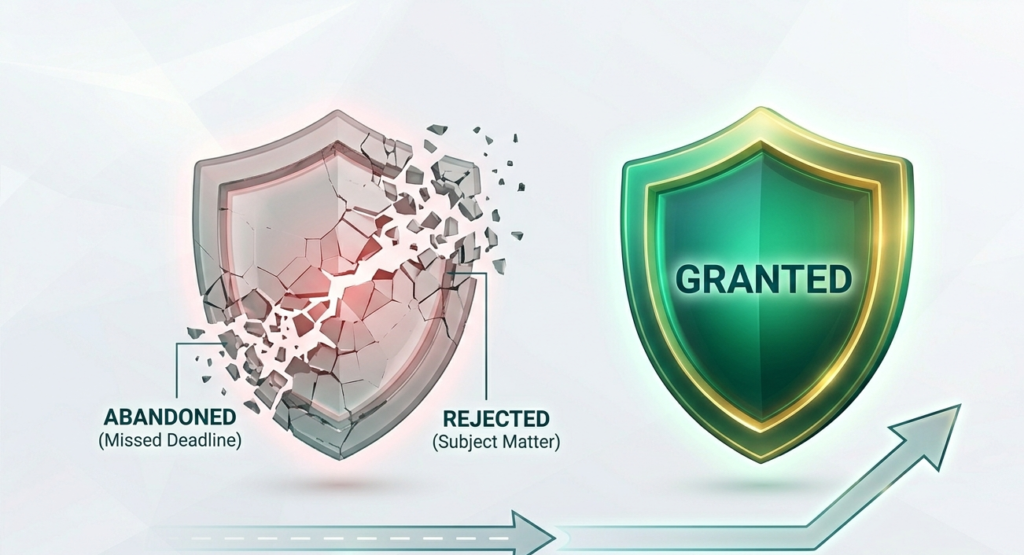
- Rejected / Abandoned / Withdrawn
Not every patent application is granted. In certain circumstances, an application may result in unfavourable outcomes for a variety of reasons.
Possible outcomes include:
- Rejected: The application is refused by the patent office if it does not meet the required patentability criteria, such as novelty, inventive step, or industrial applicability.
- Abandoned: The application is deemed abandoned if the applicant fails to meet prescribed deadlines or does not respond to official communications within the stipulated time.
- Withdrawn: The application may be voluntarily withdrawn by the applicant at any stage of the process for procedural, commercial, or strategic reasons.
These outcomes result in the termination of the patent application process, and the invention does not receive patent protection.
Common Patent Status Terms Explained
Understanding these terms helps avoid confusion:
Status- Meaning
Filed- Application submitted
Published- Public disclosure of invention
FER Issued- Objections raised
Pending- Still under process
Granted- Patent approved
Abandoned- Missed deadlines
Disposed- Final decision made
Timeline of Patent Filing Status in India
The patent process is time-consuming and involves multiple stages.
Typical timeline:
Filing to publication → ~18 months
Examination to grant → 2–5 years
Total process → 3–5 years
Why Tracking Patent Filing Status is Important
Tracking your patent status is not just optional—it is essential.
Key reasons:
Avoid missing deadlines
Respond to objections on time
Improve chances of grant
Stay informed about progress
Plan licensing or commercialization
Expert Tips to Manage Patent Filing Status
Here are some practical tips:
- Check Status Regularly
Monitor updates frequently
Especially after FER issuance
- File RFE on Time
Without RFE, your application will not proceed
- Respond to FER Carefully
Provide technical justification
Amend claims strategically
- Maintain Proper Documentation
Keep all filing records
Track deadlines
- Seek Professional Help
Patent agents improve success rate
Reduce chances of rejection
Common Mistakes to Avoid
- Avoid these common errors:
- Ignoring patent status updates
- Missing FER response deadline
- Not filing RFE
- Weak patent drafting
- Lack of prior art search
Real Challenges in Patent Filing Status
Many applicants face practical challenges such as:
- Delays due to backlog
- Complex legal terminology
- Long examination timelines
Patent office process applications in multiple stages, which can take several years due to detailed technical scrutiny.
Patent Filing Status in Global Context
While this blog focuses on India, globally:
Patent systems follow similar stages
Timelines vary by country
Status tracking is available online
This makes it easier for applicants to manage international filings as well.
How Patent Status Affects Commercialization
Your patent status directly impacts business decisions:
Pending patent → Can attract investors
Published patent → Adds credibility
Granted patent → Full commercial rights
Understanding status helps in:
Licensing deals
Technology transfer
Startup valuation
Strategic Insight: Why Status Matters More Than You Think
Many inventors focus only on filing but ignore tracking.
In reality:
Filing = starting point
Status tracking = success factor
A well-managed patent application has:
Timely responses
Strong claims
Higher grant chances
Conclusion
Patent filing status is a critical aspect of the patent lifecycle that every inventor must understand. From filing to grant, each stage reflects the progress and requirements of your application.
By regularly tracking your patent status, responding promptly to objections, and understanding each stage, you can significantly improve your chances of securing a patent.
In this blog, we explored the complete concept of patent filing status, its stages, timelines, and expert strategies to help you navigate the patent process effectively.
Final Thought
A patent is not just about filing it’s about managing the journey until grant.